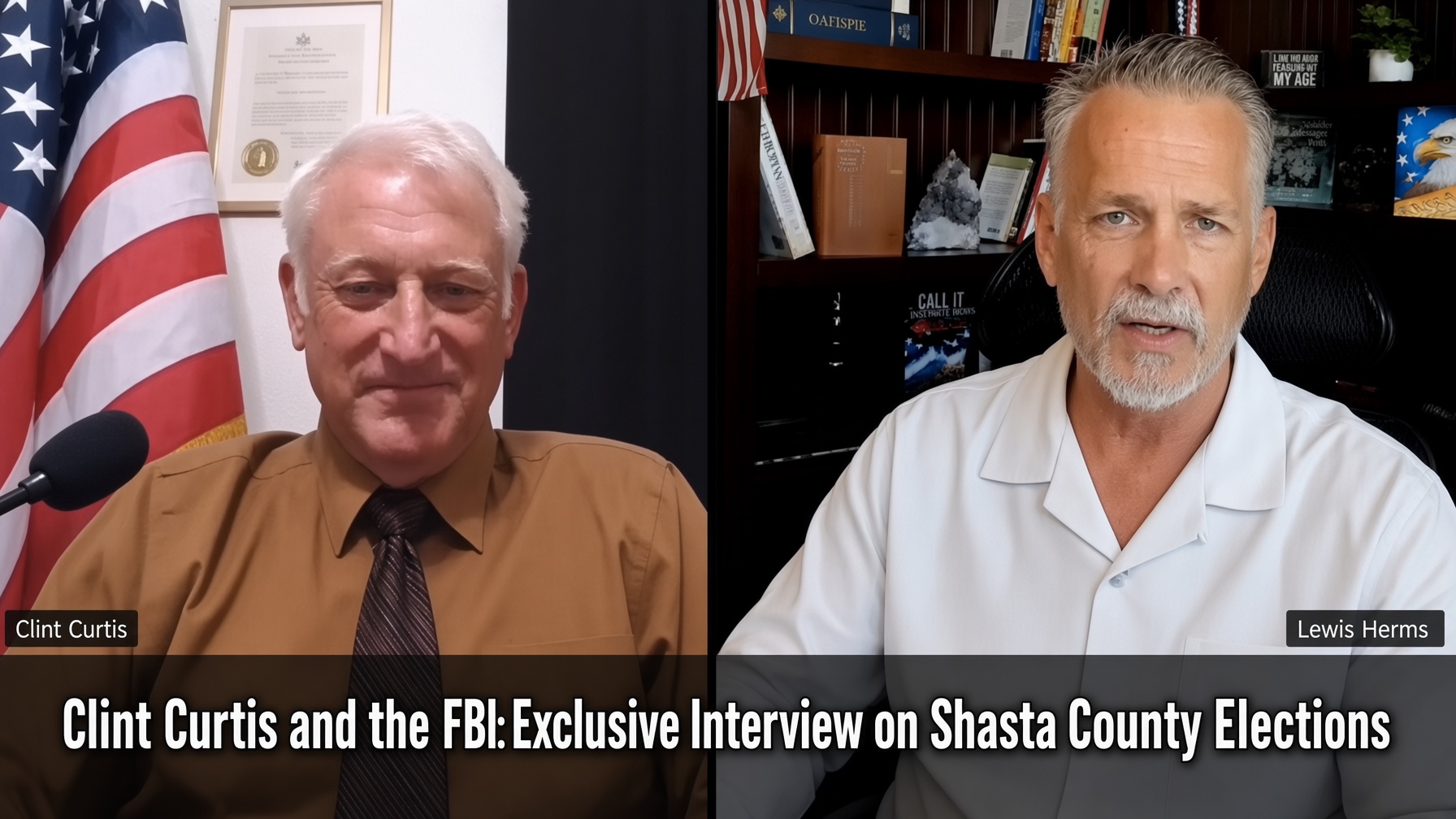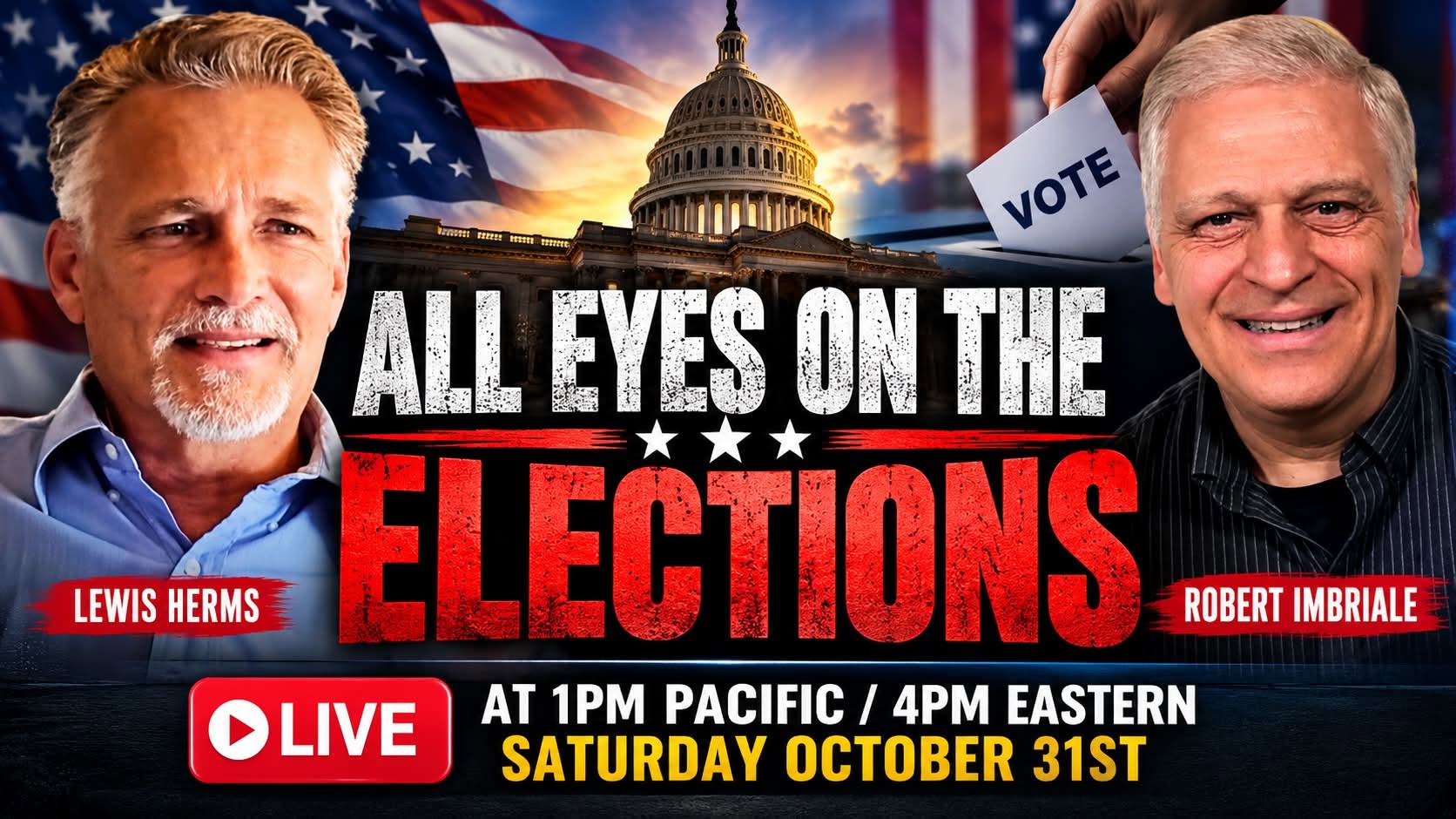
Election fraud in California is the main topic of All Eyes on the Elections, a ScrewBigGov livestream with host Lewis Herms and guest Robert Imbriale. Herms ran for governor of California and calls himself “pretty much the chief election investigator” for LA County alongside his colleague Christine.
In this episode, he and Robert explain what that work turned up, why they say staying home on election day backfires, and what’s happening in elections in other countries.
This post sums up the main points from the conversation. All claims are the speakers’ own, as said on the show. Watch the full video on Rumble.
“Chaos Is Cool”: Why Disruption Comes First
Robert starts with his new saying: “chaos is cool.” He compares the moment to a seed breaking through its shell, or a bodybuilder who has to break the body down before building it back up. “You can’t get there without the chaos,” he says.
Herms agrees. He says society has long wanted a transparent, honest government and more freedom, and getting there means breaking from where things have been going. “Guaranteed it’s going to be tough,” he says, “but at the end of the day, I’m very hopeful.”
Elections Under Pressure Around the World
The hosts list several countries as examples:
• Brazil: They argue the election was a “clear win for Bolsonaro” and a “clear steal” for Lula. They point to a two-hour extension and to precinct results such as 1,000 votes for Lula and zero for Bolsonaro, which they call “impossible numbers.”
• Poland: Herms describes the president turning his plane around during what he calls an attempted coup by the prime minister. He says the president went back and removed five judges who had been appointed illegally.
• France: Robert says the French “are now standing up and they’re saying no more.”
Why the “Don’t Vote” Movement Worries Herms
The episode’s strongest argument is aimed at people who say, “the elections are rigged, so don’t vote.” Herms says he understands the frustration but warns about what could happen:
“The one time you get a high enough percentage and convince them not to vote will be the time that the Deep State cabal publicly will call for an audit… and they will use that as their bludgeon to never let anybody talk about election fraud again.”
His conclusion: “It’s better to vote in a broken system to at least always have enough evidence so when the time is right… it’s gonna be easy to expose it.” When a viewer said the no-vote crowd is small, Herms answered that it could still sway the much larger group of apathetic voters and fence-sitters.
Do You Even Know Your Vote Counted?
Robert raises a practical problem. California tells you it received your ballot, but not what was counted. Ballots carry a voter ID and go through a tabulator, so he asks why the state can’t show voters what was recorded for them. “Do I know that it counted? Did I know that it didn’t get choked in the machine?… I don’t know anything.”
Inside the Investigation of Election Fraud in California
Herms says he and Christine visited all 58 county election offices in California. He calls that unprecedented, and says they interviewed more than 30 top election officials.
“California Just Tells Us to Process It”
At the end of each interview, Herms asked what officials do about a fraudulent ballot that is mailed or delivered to them. He says every official gave the same answer: “California just tells us to process it.
We’re not investigating anything.” He adds that it isn’t written law but a verbal mandate passed along on conference calls. He also says an official told him his face and website had been shown on those calls ahead of his visits.
700,000 Undeliverable Ballots in LA County
Herms calls this the strongest evidence in the episode. He says LA County had about 700,000 ballots marked undeliverable as addressed (UAA), which he says is six times the national average. When his investigator compared those addresses with voter records, he says about 130,000 of them still cast a vote, roughly 19%, against a national average he puts around 1%.
Robert brings in his background in direct mail. When he sent 50,000 letters a week, more than 1% returned as undeliverable meant something was wrong, and those returns came back to the sender.
Herms says his investigator saw “a pallet of UAAs” at the counting office. He says that when they filed FOIA requests, the USPS told them it didn’t know if it would ever be able to provide the data. “If that alone isn’t a cover-up,” he says.
Shasta County and the Shredder Trucks
Herms talks about Shasta County, which tried to hand count ballots under cameras. He says the tabulator is still a “black box” and that totals can change downstream with no chain of custody. In a self-audit, Shasta County found ballots printed on different thicknesses of paper.
He says the FBI is now investigating the 2026 election there, with Homeland Security involved. Weeks later, he says, shredder trucks arrived and destroyed 2024 ballots and related records.
Voting Machine Security: The Air-Gap Argument
Officials insist the machines can’t reach the internet. Herms says that misses the point. On election night, he says, each county moves a drive from the offline machine to a computer that connects to the county, the state and the mainstream media.
Robert adds that the machines have an Ethernet port plus Wi-Fi, cellular and Bluetooth chips, and that election workers are told to call for remote support. “How do you do that without internet?”
Herms also says a longtime California election official told him privately that anyone claiming the machines can’t be hacked is telling “a bold-faced lie,” and that a team could get in “within minutes.” Robert brings up Tina Peters, saying a batch file she exposed turned off the machine’s security before Windows loaded.
Controlled Opposition and Hidden Support
Both hosts call Fox News and much of conservative media “controlled opposition.” Robert, using marketing terms, describes it as grabbing market share by pretending to be what people want.
Herms says many Republicans told him privately during his run, “You have my private support… we can’t support you publicly.” He also says a top California GOP chairman has now asked him to run for Congress, which he turned down because “both parties are corrupt.”
Reasons for Hope
Herms points to Secretary of War Pete Hegseth’s statement that every branch of the military will be involved in election cybersecurity, which he calls unprecedented. He expects major developments around mid-December, when he says post-election evidence has to be turned over.
Freedom in Action: A New Tool for Grassroots Action
Near the end, Herms shows the Freedom in Action app, which he says took three years to build. He says it cost well over $100,000. It’s at freedominaction.net and on Google Play.
Apple has turned it down so far, but iPhone users can run it in a browser at the website. He describes a social feed with no algorithm, local event alerts for things like board of supervisors meetings, guides on FOIA requests and constitutional strategies, resources for food sovereignty and emergency preparedness, and filters that let users block content such as AI-generated posts. He says it’s all free.
Put Your Election Officials on Notice
Herms’s answer to election fraud in California and beyond is a tool Robert built for ScrewBigGov: a free page at screwbiggov.com/elections. He explains that Harmeet Dhillon sent a letter to all the states and many counties, warning election officials that they were being watched and could be held accountable, possibly for treason, if they don’t do their job.
Here’s how the tool works, as Herms walks through it:
1. Download the notice letter, which summarizes Dhillon’s warning, as a Word doc, PDF or plain text.
2. Pick your state and county to look up your registrar. The database shows when each entry was last verified.
3. Fill in the official’s details, then print and mail the letter or email it.
Herms suggests sending it by registered mail so you have proof. He plans to publicize how many notices each official received when the time comes. “We can’t wait… for a police officer or a governor or anybody to do this,” he says. “We are the civil servants for each other.”
Robert says he built the database with AI. After Herms called him on a Sunday asking for it, AI visited the election websites and gathered more than 8,000 records in a couple of hours, work that had been done by hand during Herms’s campaign.
“I Don’t Have Fear. I Have a Lot of Intrigue” - Robert Imbriale
Herms says someone told him they were nervous about the election. His answer: “I really don’t have fear. I have a lot of intrigue,” because “it’s not going to be business as usual. Something will happen, and if nothing happens, then we the people will happen.” He says that nearly seven years ago people were afraid to speak up online, and now they come to him asking, “What can I do? How can I get involved?” He calls that shift a big source of hope.
Conclusion: We the People Are the Plan
The episode comes back to one point: Robert says everyone stopped paying attention after Trump got elected, and that’s a huge problem.
Herms says that when more people stand up together, each person is safer, “because we have the numbers.”
Their advice is to stay engaged, keep voting so the evidence keeps piling up, put your election officials on notice and get involved locally.
Herms closes with, “There’s clearly gonna be a lot of disruption and chaos coming…
Just be patient, be in peace, be with God, and know that we’re gonna get through it.”
Thank you to our valued partners who support our mission and provide our patriots with top-shelf products and services.

Verity Metals

Syrona

Petclub 247

4R Bees

Dulsa

Ascent Nutrition
OptimizePress Popup Overlay.
Enter your details below to get instant access to [enter lead magnet name here]
We process your personal data as stated in our Privacy Policy. You may withdraw your consent at any time by clicking the unsubscribe link at the bottom of any of our emails.