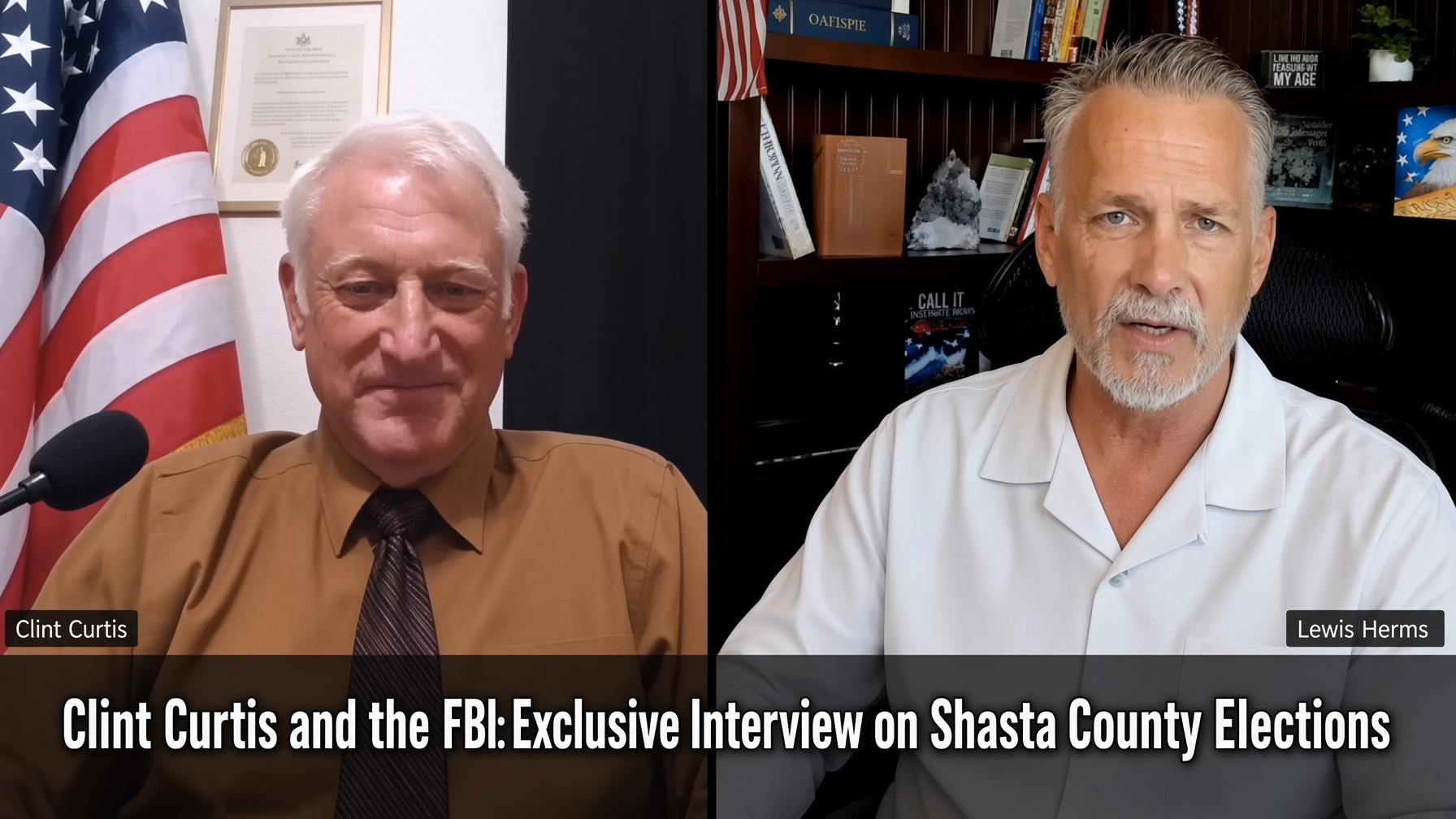
Watch the interview now:
What happens when a computer programmer is asked to create software capable of secretly flipping votes - and later takes that evidence to Congress and federal investigators? That question drives an exclusive new conversation every American concerned about election transparency should watch.
In the Rumble video “THE ELECTIONS: Shasta County ROV Clint Curtis & The FBI,” Shasta County Registrar of Voters Clint Curtis joins Lewis Herms for a detailed discussion that links his long whistleblower history directly to current events in Northern California.
The interview explores his firsthand account of being approached to build vote-flipping software, his subsequent contacts with investigators, and how those experiences shaped the transparency systems he installed once he became Registrar of Voters.
Clint Curtis and the FBI forms the central thread of the conversation. Curtis explains how his earlier experiences inform the cameras, livestreams, and documentation practices he has pushed in Shasta County.
He describes implementing systems intended to let the public observe ballot processing more closely than in previous elections, reducing reliance on drop boxes, and tightening chain-of-custody procedures.
According to the discussion, those measures helped surface irregularities in the June 2026 primary election ballots—ballots that, in his words, did not feel or look right.
Viewers hear Curtis outline the collection of evidence and sworn affidavits, the delivery of that material to the Department of Justice, and the subsequent involvement of federal investigators.
Claims that federal agents have examined aspects of the Shasta County primary process are addressed directly in the interview. Clint Curtis and the FBI is not presented as abstract history; it is framed as the through-line connecting a programmer’s refusal decades earlier to the real-time decisions of a county elections official still serving in office.
The conversation also covers the practical and political resistance Curtis has faced since his 2025 appointment. Personnel investigations, public criticism, and a primary race he ultimately lost are acknowledged.
Through it all, he maintains that visible, verifiable processes remain the only reliable path to public confidence. He links that stance back to the original software episode and the contacts with federal authorities that followed.
What makes the interview particularly compelling is the combination of personal history and institutional reality. Curtis is not speaking as an outside commentator. He is the current Registrar of Voters describing, from inside the office, the evidence he believes warrants federal attention and the systems he built to generate it.
Listeners hear him address the limits of what a county official can accomplish alone and the role he sees for federal agencies in authenticating materials when local capacity is insufficient.
The discussion does not claim every allegation has already been proven in court. Instead, it presents Curtis’s account of what he observed, what documentation he compiled, what he submitted, and why he believes the public deserves an update on the status of those submissions.
For audiences who have followed debates over machine security, observation rights, and chain of custody, the interview supplies a rare on-the-record perspective from the official who has made Shasta County a national focal point.
The historical arc is especially useful. Curtis’s early claims about being asked to create vote-altering software predate the more recent national controversies that brought election integrity into mainstream political debate.
Hearing him connect that earlier episode to the cameras, livestreams, and ballot reviews now operating in Shasta County gives the current events a longer context. It also underscores why he has repeatedly invited greater federal scrutiny rather than resisting it.
Clint Curtis and the FBI appears again as the interview turns to the practical costs of pursuing greater transparency. Curtis addresses the investigations into his own conduct, the political opposition he has encountered, and his continued insistence that the public’s ability to see the process is non-negotiable.
Whether one agrees with every administrative decision he has made, the conversation makes clear why he believes the combination of cameras, documentation, and federal involvement is necessary.
To understand the full scope of what Curtis is claiming—how the livestream system flagged specific problems, what the submitted evidence contains, how federal involvement is described, and how his earlier software episode shapes his current stance—there is no substitute for watching the interview itself.
The Rumble video delivers the unfiltered exchange between Curtis and Herms, complete with the context and nuance that any written summary cannot capture.
In an era when trust in election processes remains polarized, primary-source accounts from the officials running those processes matter.
This conversation offers one of the most direct windows currently available into both a long-standing whistleblower’s perspective and the real-time struggles of a California county elections office that has become a testing ground for greater transparency. The details, the tone, and the specific claims are best evaluated by viewing the full discussion.
Thank you to our valued partners who support our mission and provide our patriots with top-shelf products and services.

Verity Metals

Syrona

Petclub 247

4R Bees

Dulsa

Ascent Nutrition
OptimizePress Popup Overlay.
Enter your details below to get instant access to [enter lead magnet name here]
We process your personal data as stated in our Privacy Policy. You may withdraw your consent at any time by clicking the unsubscribe link at the bottom of any of our emails.