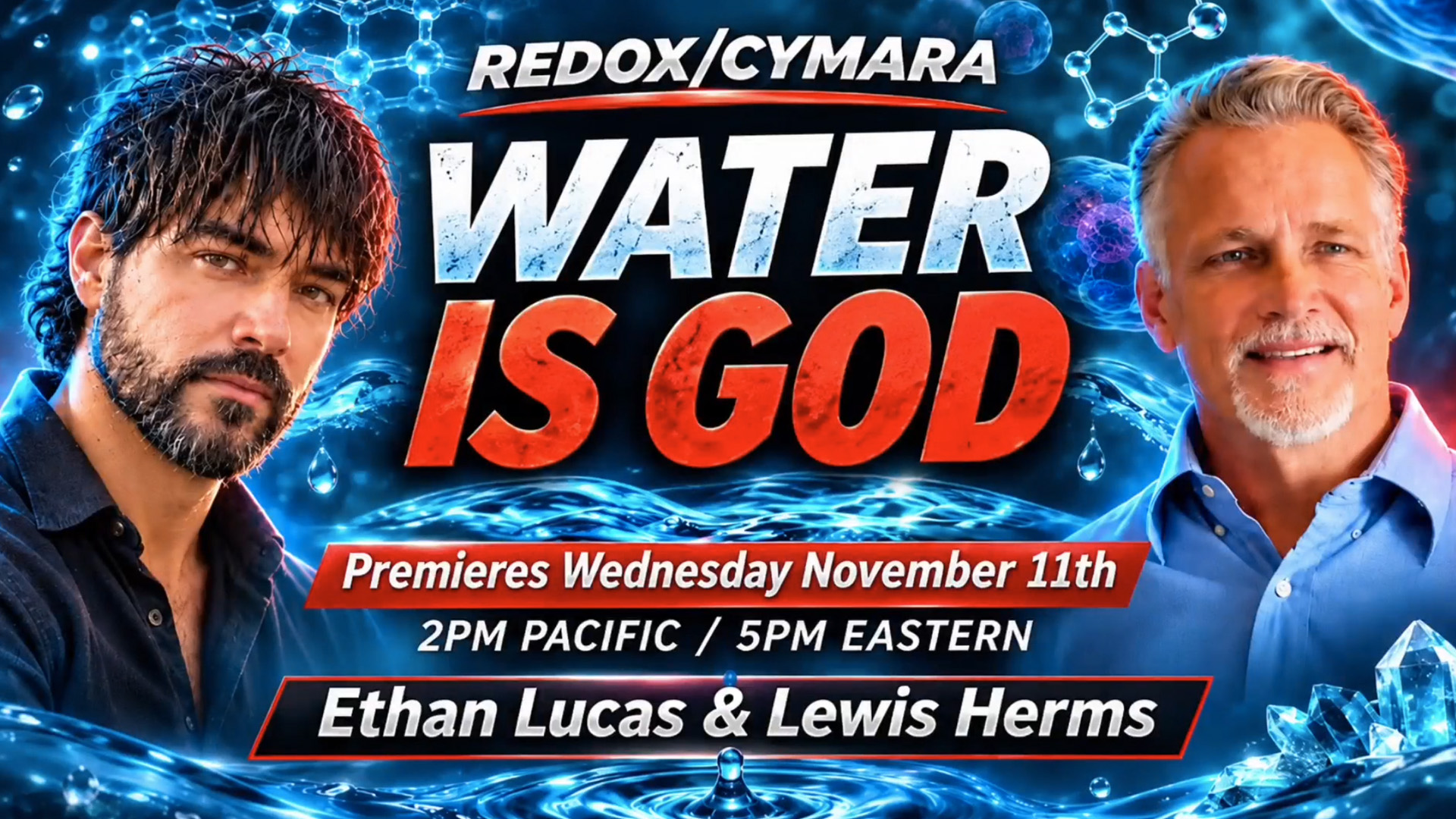
Most of us think of water as the simplest thing in the world. You drink it, you shower in it, you water the lawn with it. But what if water is far more than a passive liquid? What if the fourth phase of water holds clues to how life organizes itself, and to why scripture puts so much weight on “living waters”?
On this episode of We the People Are the Plan, host Lewis Herms of ScrewBigGov.com sits down with Ethan Lucas, founder of the nano-nutraceutical company Syrona.
Together they dig into one of the most ordinary and most mysterious substances on Earth. Their conversation covers Gerald Pollack’s exclusion zone research, Dr. Masaru Emoto, minerals and the electrical body. It ends with the age-old idea that water is a physical reflection of God.
Why “Water Is God”? The Trinity in a Single Molecule
Ethan opens with a theory he says he has investigated seriously: that the Bible speaks of God through water because water itself has a trinity structure. H2O is two hydrogens and one oxygen.
In his reading, the two hydrogens represent the Father and the Holy Spirit, the sacred masculine and the divine feminine. The oxygen, shaped like an “O,” represents the Son, the life-giver and light of the world.
He’s quick to set the symbolism aside and focus on the water itself. Still, the overlap is hard to ignore. Christianity’s earliest symbol was a fish, baptism happens in water, and scripture speaks again and again of purifying, living waters. As Ethan puts it, all that symbolism makes you wonder.
You Are Not Just a Bag of Water
We’re often told the body is 50 to 60 percent water, and some estimates run higher depending on age and body composition. Ethan argues that the percentage is the least interesting part. The real question is how water behaves once it’s inside you.
Inside a cell, water isn’t sitting still like a glass on the kitchen table. It’s packed in among membranes, proteins, enzymes, nucleic acids and mineral ions in a crowded, highly organized environment. Even conventional biochemistry now recognizes that water takes part in:
Protein folding
Enzyme activity
Ion transport
Membrane stability
Electrical signaling
In other words, water isn’t merely something your body contains. It’s part of how your body works.
Ethan offers a simple illustration. The atoms in your body don’t “know” they’re part of a human. Scatter them, and you could rearrange the same atoms into a tree, a soccer ball or a car. So what makes the difference? He believes the answer lies in organization, and in how water’s hydrogen-bond networks respond to their surroundings.
What Is the Fourth Phase of Water?
We all learned three phases of water in school: ice, liquid and vapor. Gerald Pollack, a bioengineering researcher at the University of Washington, has proposed a fourth.
Pollack and his colleagues spent years studying what happens when water touches certain hydrophilic (water-loving) surfaces. Next to those surfaces, they observed regions called exclusion zones, or EZs, where suspended particles and some dissolved substances are pushed out of the water.
That observation alone tells us something important: water near certain surfaces can behave differently from water farther away. Pollack’s interpretation goes further. He proposes that these regions are a distinct, more ordered state of water, which he calls the fourth phase of water. He links this state to charge separation, proton gradients and a response to radiant energy such as light.
Ethan is careful to draw a line here, and it’s worth repeating:
The exclusion zone phenomenon has experimental support.
The claim that it’s an entirely new thermodynamic phase of water is not yet universally accepted. Other researchers explain the effect through diffusion, surface chemistry and fluid dynamics, and the question is still under investigation.
But as Ethan points out, the fourth phase hypothesis doesn’t have to be settled for the question behind it to matter. Why does water behave differently when it meets the organized structures of a living body? The human body is filled with exactly those kinds of surfaces, from cell membranes and connective tissue to proteins and minerals.
Structured Water: Skip the Gadgets, Eat the Fruit
The fourth phase conversation leads naturally to structured water, a term you’ll see on countless machines and pitchers sold online. Ethan runs a nutraceutical company himself, and he’s blunt about it: he believes many of those devices are gimmicks.
His alternative is cheap and simple: head to the produce section. Organic blackberries, raspberries, apples and watermelon are mostly water, and Ethan argues that nature has already structured it for you.
The catch is finding clean produce. Lewis and Ethan both encourage growing your own if you can. They recommend starting from heirloom seeds, which you can save and replant year after year, rather than commercial seed that farmers have to buy again every season.
Masaru Emoto and The Hidden Messages in Water
Lewis calls Dr. Masaru Emoto’s The Hidden Messages in Water one of his favorite books. Emoto became famous for photographing water crystals and arguing that words, music and intention change how water forms. Mainstream scientists still debate his work, but it clearly struck a chord with Lewis. He now keeps his drinking water in a blue glass bottle printed with crystal patterns for love and health.
Ethan connects this to holy water. He believes the idea points to something real, even if religious institutions have distorted much of its original meaning.
Water Is Electrical
This is where the episode ties back to earlier conversations in the Body Temple series about the body as an electrical system.
Water is a polar molecule. Its oxygen atom pulls shared electrons more strongly than its hydrogen atoms do, which creates an uneven distribution of electrical charge. That polarity is a big reason water is such a powerful solvent. It lets water interact with charged particles, dissolve ions and support the electrochemical reactions that keep you alive. With a bit of wordplay, Ethan links this to El, an ancient name for God, and the “el” in electricity.
Minerals: The Body’s Wiring
The minerals dissolved in that water include sodium, potassium, calcium, magnesium and chloride. They aren’t just nutrients along for the ride. Every nerve impulse, muscle contraction and cell membrane potential depends on these charged particles moving into the right place.
Ethan explains that your nervous system doesn’t carry current the way a copper wire does. It runs on a finely regulated electrochemical system, which is why an electrolyte imbalance can show up as problems like an irregular heartbeat.
The sodium-potassium pump, powered by energy from the mitochondria, constantly moves ions across cell membranes. That maintains the gradients your cells’ electrical activity relies on, and when those gradients collapse, cells can no longer do their jobs.
In Ethan’s view, many of the problems we blame on aging come from times when the body ran low on critical minerals. He points to leg cramps, dehydration and heart palpitations as signs of those shortfalls.
Spring Water vs. Distilled Water
That’s why Ethan drinks spring water whenever he can. He avoids living on distilled or reverse-osmosis water, which he believes has been stripped of its minerals, vitality and structure. In his view, mineral-free water becomes “aggressive” and pulls minerals from the body.
If you’re rethinking your own water choices, look at where you get your minerals overall and talk with a health professional you trust.
Life Doesn’t Assemble Itself
A recent headline about a meteorite carrying the building blocks of life sparked a wider discussion about origins. Some took it as proof that life can arise on its own. Ethan offers a different analogy: your local junkyard holds all the building blocks of a car, but you won’t get a working car until intelligence puts the pieces together.
He points to biochemist Michael Behe’s book Darwin’s Black Box and its idea of irreducible complexity. Behe’s famous example is a mousetrap: remove any one of its core parts and it stops working.
Ethan argues that living systems work the same way, and water is the clearest example. Take water out of anything, and life ends.
Lewis sums it up his own way: if two rocks slammed together and created life, who created the rocks? Ethan adds that the law of entropy says things naturally break down unless intelligence steps in. For him, God isn’t a man with a white beard on a throne. Citing Romans chapter one, he describes God as an invisible, eternal consciousness, the underlying fabric of existence itself.
The Garden of Eden, Genes and Aging
Ethan also shares a more speculative idea. He sees the Garden of Eden as a sanctuary of advanced technology and biological immortality. In his reading, the tree of knowledge of good and evil was a warning against tampering with human genetics. He points out that Adam lived for centuries and that lifespans grew shorter with each generation after him.
He connects this to Dr. Bruce Lipton’s The Biology of Belief and the idea that genes can be switched on and off. He also says he believes water holds more secrets that could help reverse that decline.
Supporting the Water in Your Body
Later in the episode, Lewis and Ethan walk through several Syrona products. Ethan stresses that Syrona makes no medical claims. He doesn’t believe anything can treat, cure or prevent disease on its own, because the body heals itself when it has what it needs. Products discussed include:
Redox: a raw earth mineral supplement infused with frequencies, mixed into water
Elixir: nano glutathione with nano B12 and nano D3, designed to absorb under the tongue
Endo: full-spectrum nano CBD with vitamin E and no THC
Skin spray: nano glutathione, hyaluronic acid, collagen, B vitamins and resveratrol
Samara: a topical gel based on cymatics and frequency
Lucid: nano NAD+ for mitochondrial energy
Ethan suggests taking a product consistently for about three weeks and then pausing, to judge whether it’s helping. Syrona’s refund window is 37 days.
You can find the products at lherms-serona.org. Promo code FREESHIP gets you free shipping on orders of $99 or more, or up to 10 percent off larger orders.
Coming Up: Water Is God, Part Two
There was too much to cover in one hour. In about two weeks, Ethan returns for part two, focusing on the body’s “internal ocean” and more of the science behind water’s role in health.
Frequently Asked Questions
What is the fourth phase of water?
The fourth phase of water is a concept proposed by Gerald Pollack of the University of Washington. It describes a more ordered state of water that forms next to water-loving surfaces, separate from the familiar phases of ice, liquid and vapor. The exclusion zones behind the idea have experimental support, but scientists still debate whether they amount to a true new phase.
Is structured water real?
Water clearly behaves differently near certain surfaces, and that’s the basis of most structured water claims. On the episode, Ethan Lucas says many structured water devices are gimmicks. He recommends getting structured water from fresh fruits and vegetables instead.
Who discovered the fourth phase of water?
Gerald Pollack and his colleagues at the University of Washington popularized the idea through their research on exclusion zones. Pollack lays it out in his book The Fourth Phase of Water.
Why do some people say water is God?
Some see a trinity in water’s structure of two hydrogens and one oxygen. Others point to the central role water plays in scripture, from baptism to “living waters.” Many also note that no known life can exist without it.
Thank you to our valued partners who support our mission and provide our patriots with top-shelf products and services.

Verity Metals

Syrona

Petclub 247

4R Bees

Dulsa

Ascent Nutrition
OptimizePress Popup Overlay.
Enter your details below to get instant access to [enter lead magnet name here]
We process your personal data as stated in our Privacy Policy. You may withdraw your consent at any time by clicking the unsubscribe link at the bottom of any of our emails.